
 |
 |
|
 |
||
 |
||
 |
|
|
|
posted 10/22
|
|
|
Q & A (Sources) : The Section by the exit door looks like it's from the Sistine Chapel. How much imagery did you borrow for Tiamat?
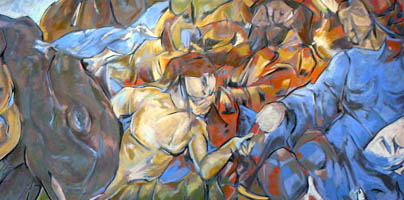 A couple of people have mentioned the similarity between this section of Tiamat and Michelangelo's Sistine Chapel. While this section was "borrowed" it wasn't from Michelangelo, at least not directly. The visual source is actually a painting by Tintoretto of Ariadne and Dionysus. I have flipped the image, gotten rid of the floating Venus and inserted another figure. In theme it is also closely linked to the Sistine Chapel (the divine touching man). For this section, I wanted a redemptive scene to balance the battle between Tiamat and Marduk which can be seen diagonally from this point. The story of Tiamat is a story of a disfunctional family, so in this scene, the royal or divine family, I have attempted to create a redemptive vision. The father figure, in A couple of people have mentioned the similarity between this section of Tiamat and Michelangelo's Sistine Chapel. While this section was "borrowed" it wasn't from Michelangelo, at least not directly. The visual source is actually a painting by Tintoretto of Ariadne and Dionysus. I have flipped the image, gotten rid of the floating Venus and inserted another figure. In theme it is also closely linked to the Sistine Chapel (the divine touching man). For this section, I wanted a redemptive scene to balance the battle between Tiamat and Marduk which can be seen diagonally from this point. The story of Tiamat is a story of a disfunctional family, so in this scene, the royal or divine family, I have attempted to create a redemptive vision. The father figure, in 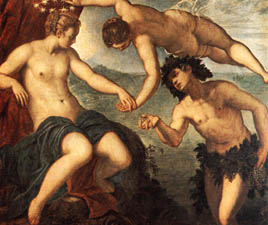 red, cups the face of the youth, while the mother figure, in Madonna blue, reaches her hand out to the child to offer a gift or endowment. In this case the gift is, as recognized by a 12-year old who visited the show on opening night, a ball of string. In this sense it is Ariadne giving the string to Theseus so he can exit the labryinth (the Minotaur is pictured on the opposite wall). In general, it is the commissioning of a Messiah figure, and if one wanted to keep it in the context of Marduk and Tiamat (which is the subject of most of this panel) one could read it as Ea and his consort sending their son, Marduk, off to battle Tiamat. red, cups the face of the youth, while the mother figure, in Madonna blue, reaches her hand out to the child to offer a gift or endowment. In this case the gift is, as recognized by a 12-year old who visited the show on opening night, a ball of string. In this sense it is Ariadne giving the string to Theseus so he can exit the labryinth (the Minotaur is pictured on the opposite wall). In general, it is the commissioning of a Messiah figure, and if one wanted to keep it in the context of Marduk and Tiamat (which is the subject of most of this panel) one could read it as Ea and his consort sending their son, Marduk, off to battle Tiamat.As someone esle mentioned, the figure of the youth seems to be eaten by the dinosaur figure to the left. The dinosaur is behemoth, a symbol in Job for the inscrutability of God. The eating of the flesh of behemoth is also a symbol in Jewish eschatological lore. The Messiah figure being eaten by the Behemoth, then, could be seen as pointing towards the Mystery of the Messiah figure, the confusion when Christ dies on the cross (which is played out on the opposite wall in the southwest corner). This scene is redemptive in another sense. Tiamat is the goddess of salt water, the oceans, or the deep. She is primordial chaos that swallows up Job. Ariadne is the greek goddess of the isles of the sea (the painting was done as a symbol of Venice) and so is a positive spin on the salt waters. 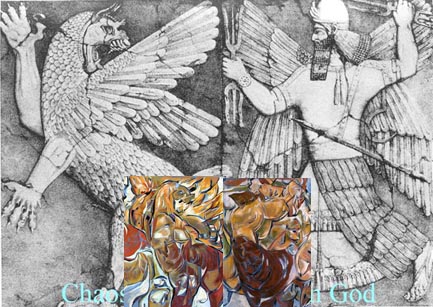 Like my use of Tintoretto, there are number of other cases where I "revised" art historical sources to my own end. The borrowing might have been direct, or I might simply have had certain work or artists in mind when I was developing a section. Below are some of the influences (thematic, stylistic, both) in Tiamat.
The battle between Marduk and Tiamat is lifted pretty directly from this Assyrian source. (left). What Marduk doesn't realize is that Chaos is never completely conquered, so he doesn't notice the swirling, salt-water form coming up behind him which has a head out of Alien and is giving birth to creatures of chaos that look like something out of Brueghel. For Behemoth I originally thought of Blakes' engraving, but I also think Walton Ford's painting of a Rhinoceros found on the cover of David Quammen's "The Boilerplate Rhino" came into play. 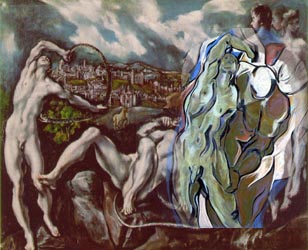 This scene, Jacob wrestling the angel, uses a figure from El Greco's Laocoon and a super-hero style angel of my own device. The story of Laocoon, the son of Priam who warns the Trojans about Greeks bearing gifts and is destroyed by sea serpents (Tiamat, Leviathan) sent from the gods because he threw a spear at the horse, works nicely with the political allegory present in other sections. Also, I liked what the National Gallery's catalogue said about El Greco's reasons for executing the Laocoon, his only work dealing with Greek mythology. The famous Roman/Greek sculpture of Laocoon and his sons was discovered during El Greco's lifetime and the National Gallery's catalogue theorizes that El Greco was trying to prove that he could outdo the sculpture in his own medium, painting. In my version, one of Laocoon's two sons wrestling with a serpent becomes one of Isaac's sons (Jacob) wrestling with an angel/god/himself before crossing a river to meet the supposed wrath but actual redemptive forgiveness of his brother, Esau. This section sits between the emergency exit door and the doorway into the other gallery. This scene, Jacob wrestling the angel, uses a figure from El Greco's Laocoon and a super-hero style angel of my own device. The story of Laocoon, the son of Priam who warns the Trojans about Greeks bearing gifts and is destroyed by sea serpents (Tiamat, Leviathan) sent from the gods because he threw a spear at the horse, works nicely with the political allegory present in other sections. Also, I liked what the National Gallery's catalogue said about El Greco's reasons for executing the Laocoon, his only work dealing with Greek mythology. The famous Roman/Greek sculpture of Laocoon and his sons was discovered during El Greco's lifetime and the National Gallery's catalogue theorizes that El Greco was trying to prove that he could outdo the sculpture in his own medium, painting. In my version, one of Laocoon's two sons wrestling with a serpent becomes one of Isaac's sons (Jacob) wrestling with an angel/god/himself before crossing a river to meet the supposed wrath but actual redemptive forgiveness of his brother, Esau. This section sits between the emergency exit door and the doorway into the other gallery.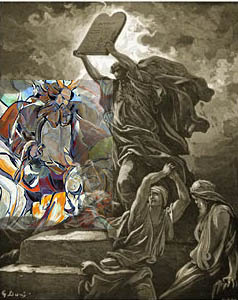 The figure of Noah/Marduk/Akhenaten was orignally inspired by Gustave Dore's engraving of Moses holding the tablets aloft. It struck me that Moses looked like a wrestler holding his champion belt above his head and as such would fit the triumphant Marduk after he slays Kingu. The drawing eventually went through some transformations (the paper was really too horizontal for the Dore figure) but retained some elements from Dore. Adam and Eve as conjoined twins resembles the alchemical figure of the hermaphodite in the Aurora Consurgens, but really it is a Fabio-esque version of myself and and a Marilyn Monroe version of my wife. The idea of the human-headed salamander comes from a painting by Hugo van der Goes. The head ended up resembling a more contemporary figure, however. 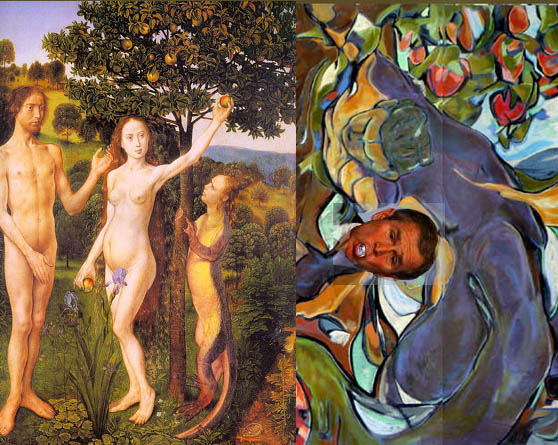 The statue of Saint Paul as Obi-wan-kenobi holding the flaming sword (at the end of the east wall) is based on the statue in front of Saint Paul's Basilica in Rome. An arab looking figure dressed up as Abraham from the papryi image published by Joseph Smith. 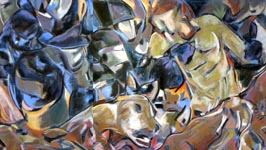 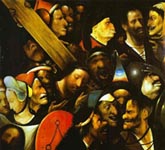 The three figures of soldiers in Iraq were taken from a news photograph but as they were drawn out came to remind me more of Brueghel's "Blind leading the Blind." Which is appropriate because the scene of the riot police is related to Bosch's "Christ Carrying the Cross". 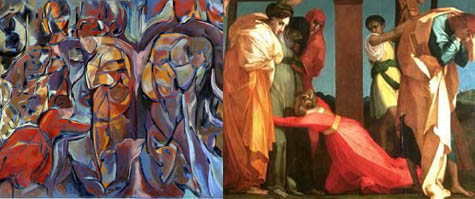 This is a transformation of the bottom of Rosso Fiorentino's Deposition from the Cross, one of my favorite. This is a transformation of the bottom of Rosso Fiorentino's Deposition from the Cross, one of my favorite.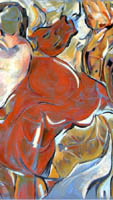 The red heifer flipped around resembles the figure of a bull on a coat of arms. There is a long tradition of seeing a relation between the British Isles and the Christian story (including the lost ten tribes and the holy grail). Some see the coat of arms of England as a symbol of the prophecies of Ephraim and Manasseh (Lion and the Bull -- unicorn being a mistranslation) and the present-day incarnations of these prophecies being England and the U.S. (or sometimes Canada). Here's a page from a religious group in Vancouver. The red heifer flipped around resembles the figure of a bull on a coat of arms. There is a long tradition of seeing a relation between the British Isles and the Christian story (including the lost ten tribes and the holy grail). Some see the coat of arms of England as a symbol of the prophecies of Ephraim and Manasseh (Lion and the Bull -- unicorn being a mistranslation) and the present-day incarnations of these prophecies being England and the U.S. (or sometimes Canada). Here's a page from a religious group in Vancouver. |
|
|
posted 10/19 |
|
|
Brian Staker's review of Tiamat appears in this week's edition of Salt Lake Weekly. I've included the link at the top of this page. Speaking of reviews, today's Q & A will address something in Dave Gagon's review (Deseret News).
Q & A: The Deseret News review mentioned "genetically engineered livestock, UFOs, Jewish holy days, political allegories, controversial Egyptian texts, conjoined twins, riot police, sin, evil, grace, redemption, dinosaurs, rabid dogs, human-headed salamanders." Where is all that stuff? Most of those terms were lifted from a press release I sent to Dave Gagon to catch his attention and get him to come check out the show. Apparently it worked, because he came and reviewed the exhibition but he also used my press release and so now I suppose I'm responsible to explain. Explaining where these things are in the piece will get us towards a "reading" (or at least hints of one) of the entire work so this may get a bit complicated. Everything in the piece hopefully has multiple associations and can be read differently depending on what other part of the piece they are being read with (in a ricochet rather than linear way). But here's a look at some of the things Dave talked about. 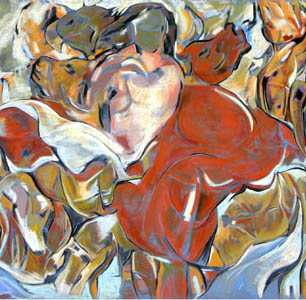 "Genetically engineered livestock" and "UFOs" are actually found in the same spot, pictured here. This four-headed figure relates to Ezekiel's vision in the Old Testament. In a nice example of literary revisionism, the lion, eagle, man and bull are also the symbols for the four evangelists of the New Testament. Some people (Biblical literalists who believe in UFOs) think that Ezekiel's vision of the four headed beast is evidence of UFOs. Click here for an example. "Genetically engineered livestock" and "UFOs" are actually found in the same spot, pictured here. This four-headed figure relates to Ezekiel's vision in the Old Testament. In a nice example of literary revisionism, the lion, eagle, man and bull are also the symbols for the four evangelists of the New Testament. Some people (Biblical literalists who believe in UFOs) think that Ezekiel's vision of the four headed beast is evidence of UFOs. Click here for an example. Originally in the drawing, the bull's head was simply attached to the full figure of the man as are the lion and eagle. But as the drawing progressed it also morphed into a body of its own -- a very red one. At this point the image takes on a life of its own and becomes the red heifer, which is important in current Jewish theology. The ashes of a perfect red heifer are necessary for the Jewish people to purify themselves before they can rebuild the temple in anticipation of the Messiah. To rebuild the temple, however, would mean the destruction of the Mosque which now sits on Temple Mount. This could lead to a major war. Or Armageddon? In 1997, a red heifer was born in Israel. There are some that contend that this was the result of an artificial insemination for the purpose of producing a red heifer. The heifer eventually sprouted white hairs and so was considered impure. There are currently some American breeders that are working hard to provide red heifers to Israel. 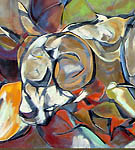 Jewish holy days refers to Rosh Hashanah, the Jewish "New Year" (actually one of four) which this year was September 22nd, the opening of Tiamat. Rosh Hashanah is the beginning of Tishri, a month taken by the Jews from the Babylonian calendar. It marks the symbolic anniversary of the creation of the world. The Babylonian celebration of the New Year actually occurs in the Spring; it was at this time that they celebrated the destruction of Tiamat by Marduk. Rosh Hashanah is marked by the blowing of the shofar, the ram's horn. I think the curve of the ram's horn can be seen throughout the entirety of the drawing, but you can also find it specifically on the East wall. Jewish holy days refers to Rosh Hashanah, the Jewish "New Year" (actually one of four) which this year was September 22nd, the opening of Tiamat. Rosh Hashanah is the beginning of Tishri, a month taken by the Jews from the Babylonian calendar. It marks the symbolic anniversary of the creation of the world. The Babylonian celebration of the New Year actually occurs in the Spring; it was at this time that they celebrated the destruction of Tiamat by Marduk. Rosh Hashanah is marked by the blowing of the shofar, the ram's horn. I think the curve of the ram's horn can be seen throughout the entirety of the drawing, but you can also find it specifically on the East wall.Political Allegories -- This runs throughout the piece: In the figure of Marduk, a young God trying to take the place of his father (Ea) who attempts to destroy chaos and create a new world. In the story he does this, but in the process unleashes a number of additional evils and finds that he must destroy chaos over and over again at the New Year. It's also in the references to the story of the Minotaur, where King Minos seeks for validation for his rule, only to ignore what the Gods ask of him when he receives it. The result is the Minotaur, surrounded by a labrynth (quagmire) to which the youths of Athens are sacrificed. And if you look in the garden scene you might find a tongue-in-cheek reference that would delight Hugo Chavez. 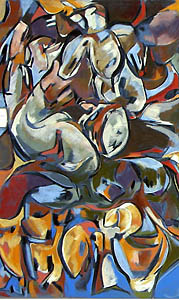 Controversial Egyptian Texts refers to the "Book of Abraham," a part of the Mormon scripture which Joseph Smith claimed to have translated from ancient papyri. The papyri were destroyed in a fire but fragments have been recovered. One of these is a partial image which corresponds to an image Joseph Smith published that depicts the patriarch Abraham as a young man about to be sacrificed on an altar by his father. The discovered fragment only shows the bottom portion. The missing upper portions have been drawn in to complete a picture, though it is unclear by whom. Egyptologists say the image is a very ordinary Egyptian funeral text that has nothing to do with Abraham and that Joseph Smith filled in the missing parts according to his own imagination. Whether Joseph Smith was looking at a 2nd century papryi that was a Jewish revision of a traditional funeral text and transcribed it, or he found a torn papryi and filled in the blanks to fit his own ends, I liked the idea of revisionism (and if you read the story I think it's a powerful one) and it seemed only fitting to include a controversial part from my own religious tradition. Controversial Egyptian Texts refers to the "Book of Abraham," a part of the Mormon scripture which Joseph Smith claimed to have translated from ancient papyri. The papyri were destroyed in a fire but fragments have been recovered. One of these is a partial image which corresponds to an image Joseph Smith published that depicts the patriarch Abraham as a young man about to be sacrificed on an altar by his father. The discovered fragment only shows the bottom portion. The missing upper portions have been drawn in to complete a picture, though it is unclear by whom. Egyptologists say the image is a very ordinary Egyptian funeral text that has nothing to do with Abraham and that Joseph Smith filled in the missing parts according to his own imagination. Whether Joseph Smith was looking at a 2nd century papryi that was a Jewish revision of a traditional funeral text and transcribed it, or he found a torn papryi and filled in the blanks to fit his own ends, I liked the idea of revisionism (and if you read the story I think it's a powerful one) and it seemed only fitting to include a controversial part from my own religious tradition.Conjoined Twins. While I was working on Tiamat a pair of conjoined twins was succesfully separted in Utah. At the same time, I was reading a book on genetic mutations and I was interested by the theological difficulties posed by certain genetic mutations. I pictured Adam and Eve in the garden as conjoined twins (the Hebrew word translated as "rib" is most often translated as "side"). Conjoined Adam and Eve has reference to certain alchemical texts, but more importantly has theological and interpersonal repercussions, played out in other parts of the work. Sin, Evil, Grace, Redemption Well there is enough in there for a dissertation so I'll have to save that for a different post. 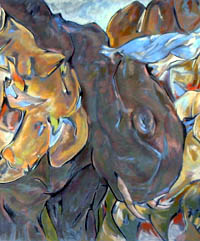 Dinosaurs refers to the large figure on the North wall (which many people have identified as a dinosaur). In the work this is Behemoth, one of two large creatures (the other is Leviathan, the sea serpent, also pictured) mentioned in the Bible which many scholars believe is a remnant from Babylonian myth. In the Book of Job behemoth is a symbol of the power and inscrutability of God. In Jewish lore, the righteous will feast on the flesh of behemoth after the coming of the Messiah. Some biblical literalists believe behemoth is actually a reference to dinosaurs, proof that man and dinosaurs lived at the same time and the Earth is not as old as commonly believed. Dinosaurs refers to the large figure on the North wall (which many people have identified as a dinosaur). In the work this is Behemoth, one of two large creatures (the other is Leviathan, the sea serpent, also pictured) mentioned in the Bible which many scholars believe is a remnant from Babylonian myth. In the Book of Job behemoth is a symbol of the power and inscrutability of God. In Jewish lore, the righteous will feast on the flesh of behemoth after the coming of the Messiah. Some biblical literalists believe behemoth is actually a reference to dinosaurs, proof that man and dinosaurs lived at the same time and the Earth is not as old as commonly believed.Riot Police. In addition to being the names of two mythological beasts in the Bible, Leviathan and Behemoth are also titles for works by 17th century political philosopher Thomas Hobbes. In Tiamat these appear opposite the mythological beasts on the south wall in the form of soldiers in Iraq (anarchy) and riot police (the police state). 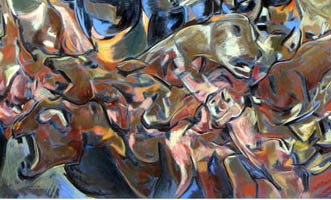 Rabid Dogs are one class of beasts loosed by Tiamat when her husband is killed by the younger Gods. In the drawing the also serve as part of the text of political allegory. When I saw the dogs begin to appear in the drawing (just below the riot police and leading towards the soldiers) I thought of Shakespear's line "Cry havoc and let loose the dogs of war." This appears in "Julius Caesar," the story of the assasination of a dictator. Marc Anthony speaks it while in private, lamenting the act of Brutus and the others and seeing the future -- "havoc" was the military call that meant it was okay to rape and pillage. In public, though, Marc Anthony put on a good face, played the good soldiers and put the country at ease with his "Friends, Romans, countrymen, give me your ears . . ." It is a general statement about certain military decisions but also a reference to Colin Powell and other leaders who didn't publicly speak their mind. Rabid Dogs are one class of beasts loosed by Tiamat when her husband is killed by the younger Gods. In the drawing the also serve as part of the text of political allegory. When I saw the dogs begin to appear in the drawing (just below the riot police and leading towards the soldiers) I thought of Shakespear's line "Cry havoc and let loose the dogs of war." This appears in "Julius Caesar," the story of the assasination of a dictator. Marc Anthony speaks it while in private, lamenting the act of Brutus and the others and seeing the future -- "havoc" was the military call that meant it was okay to rape and pillage. In public, though, Marc Anthony put on a good face, played the good soldiers and put the country at ease with his "Friends, Romans, countrymen, give me your ears . . ." It is a general statement about certain military decisions but also a reference to Colin Powell and other leaders who didn't publicly speak their mind.Human-headed Salamander appears in the garden, the purple creature whose tail turns into the green serpent that wraps around the garden. The human-headed salamander appears in a painting by Hugo van der Goes (a serpent looking like a salamander with its legs and arms cut off). The salamander is an interesting symbol though, because it was considered both a poisoner (the devil) as well as a righteous man (the salamander was believed to be able to withstand fire and so was like the righteous man who could withstand temptation). 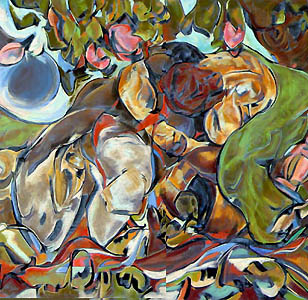 Vampires. One thing Dave didn't mention but which was in my press release to him was the mention of vampires, which you'll find in the garden. To the left of Adam and Eve is a scene of Cain and Abel. I have pictured Abel as dark skinned to counter the unfortunate belief held by some Christians (including some Mormons) that the mark of Cain was a dark skin. I have also shown Cain as a vampire, biting the neck of his brother. That Cain was the progenitor of vampires was a common belief in Victorian times (he was cursed to roam the earth and never be killed). On of the more interesting things about the Cain and Abel story I found (but which is not included in Tiamat) is the Moslem/Palestinian folktale about why Cain killed Abel. It's a love story. Vampires. One thing Dave didn't mention but which was in my press release to him was the mention of vampires, which you'll find in the garden. To the left of Adam and Eve is a scene of Cain and Abel. I have pictured Abel as dark skinned to counter the unfortunate belief held by some Christians (including some Mormons) that the mark of Cain was a dark skin. I have also shown Cain as a vampire, biting the neck of his brother. That Cain was the progenitor of vampires was a common belief in Victorian times (he was cursed to roam the earth and never be killed). On of the more interesting things about the Cain and Abel story I found (but which is not included in Tiamat) is the Moslem/Palestinian folktale about why Cain killed Abel. It's a love story.
|
|
|
GOOGLE SEARCH
Here are some terms you might try entering into google as an aid towards reading Tiamat. Let the surfing and the free associating begin: Tiamat, Hieronymous Bosch, Harold Bloom, Marduk, Kingu, Ezekiel's vision, Enuma Elish, Peter Brueghel, Rosso Fiorntino, Tintoretto, Thomas Hobbes, Book of Abraham, Minotaur, Ariadne, behemoth, Paul Ricoeur, red heifer, rosh hashanah, hugo van der goes, Moses, agon, leviathan, Ahkenaten, stag, dogs of war. |
|
|
posted 9/26
|
|
|
posted 10/14
|
|
|
Q & A: How long did it take you to do this? Did you plan it all out in advance?
My response to the first question would all depend on what would impress you more -- if I had been working on it for years or was able to pull it off in a couple of months. To some I have replied "My whole life" which is a sarcastic act of deflection but does hold some truth. It might be more appropriate to say for about 15 years, i.e. back to my college days, because as I worked on it I was reminded of the number of very intelligent professors who taught me how to read literature. Because in many respects this piece is a text, a text about the problems and possibilities of reading a text. The "real" answer, though, is: about two intense months with little sleep. I applied for the exhibit at Finch Lane about a year and a half ago and after being accepted for a show thought little about it until this summer when it became impossible to postpone any longer. But I found that I might have postponed too long. When I went to order the paper (5' x 33' sheets of Canson mi-teinte) I found out that Canson had stopped making the paper a few years ago. The only reason I had found some for Gilgamesh (in 2005) was that the remaining stock was still being liquidated through various suppliers. All those suppliers had run out, however, and the only available rolls were in black and white (black unsuitable for the use of charcoal, and white terrible to work with in pastel). I thought I had tracked down a few rolls from a supplier in Belgium and, sweating a little by this time, was getting my credit card out to pay for the international shipping when they informed me that they no longer had any available. By this time (late July) I was starting to feel a little desperate, but I eventually found some rolls of colored paper available: flourescent blue, bright yellow, and a neutral blue. I ordered five rolls of the latter.  When I pinned up the first roll in my studio I had no preliminary drawings. I had a rough idea for the theme -- Tiamat, chaos, religion, hermeneutics -- but that was about it. I immediately starting laying out some loose lines across the paper. It wasn't really "automatic" drawing because I was putting down certain types of lines --arcs and curves that could describe body parts, as opposed to say, loose scribbling ala Twombly. From these lines I started to pick out forms and movements. Simultaneously I was studying (through books and the internet) my theme and used what I found (in addition to my previous knowledge and background) and let it interact with the drawing to develop it in certain directions. As much as possible, I left things up to chance, allowing da Vinci's idea of looking at stains on a wall and seeing interesting forms in them. For as complex a work as I ended up developing, however, there came moments when I had to plan things out, and the further I progressed the more I had to keep things in mind, develop relationships, plot out figures, etc. My references to art history, religion, philosophy all required some planning, but whenever possible I allowed the drawing to be as free as possible, and the chance occurence or difficulties caused by lack of planning often provided interesting aspects to the drawing (Adam and Eve were drawn free hand with no planning and you can see that I got to a point where the legs were going to be cut off just below the knee by the bottom of the paper; the foliage I eventually put in covers up this difficulty but also allowed me to portray the couple as if they are emerging from the ground and foliage of the garden of itself which related to some of the themes in the drawing). When I pinned up the first roll in my studio I had no preliminary drawings. I had a rough idea for the theme -- Tiamat, chaos, religion, hermeneutics -- but that was about it. I immediately starting laying out some loose lines across the paper. It wasn't really "automatic" drawing because I was putting down certain types of lines --arcs and curves that could describe body parts, as opposed to say, loose scribbling ala Twombly. From these lines I started to pick out forms and movements. Simultaneously I was studying (through books and the internet) my theme and used what I found (in addition to my previous knowledge and background) and let it interact with the drawing to develop it in certain directions. As much as possible, I left things up to chance, allowing da Vinci's idea of looking at stains on a wall and seeing interesting forms in them. For as complex a work as I ended up developing, however, there came moments when I had to plan things out, and the further I progressed the more I had to keep things in mind, develop relationships, plot out figures, etc. My references to art history, religion, philosophy all required some planning, but whenever possible I allowed the drawing to be as free as possible, and the chance occurence or difficulties caused by lack of planning often provided interesting aspects to the drawing (Adam and Eve were drawn free hand with no planning and you can see that I got to a point where the legs were going to be cut off just below the knee by the bottom of the paper; the foliage I eventually put in covers up this difficulty but also allowed me to portray the couple as if they are emerging from the ground and foliage of the garden of itself which related to some of the themes in the drawing).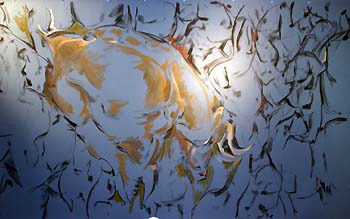 This is an image of the northwest wall (the first I worked on) in an early stage. The form of the bull/bison in the center, which I have just begun to color in this photo, was a happy accident that came due to the process of semi-automatic drawing. I had no plans for a bull/bison figure but liked the form very much when my eyes began to see it. Luckily it turns out for me that Marduk, the young Babylonian god who slays Tiamat, literally means "bull calf of the sun." The bull ended up becoming an important motif throughout the drawing, appearing in the Minotaur of the south wall and the Ephraim Bull/red heifer of Ezekiel's vision on the southwest wall. That I am a Taurus is a nice coincidence. This is an image of the northwest wall (the first I worked on) in an early stage. The form of the bull/bison in the center, which I have just begun to color in this photo, was a happy accident that came due to the process of semi-automatic drawing. I had no plans for a bull/bison figure but liked the form very much when my eyes began to see it. Luckily it turns out for me that Marduk, the young Babylonian god who slays Tiamat, literally means "bull calf of the sun." The bull ended up becoming an important motif throughout the drawing, appearing in the Minotaur of the south wall and the Ephraim Bull/red heifer of Ezekiel's vision on the southwest wall. That I am a Taurus is a nice coincidence. |
|
|
posted 10/10
|
|
|
Q & A
Some of you have been asking me questions about the work, either by email or in person, so I thought I would start addressing some of the elements in the piece by responding to the these questions in a series of posts over the next week or so. Why did you decide to cut the piece up? Why not find a public space that would hang it? Apart from the actual difficulty of finding such a place in Utah (the same issue came up with Gilgamesh, which was not cut up but which for lack of a permanent hanging place is now rolled up in my garage), there are a couple of theoretical issues that I wanted to explore which made the remix process important for me. PUBLIC VS. PRIVATE: One of the leading issues in a lot of contemporary art is a critical discussion of the difference between art as a private and public experience. I wanted this piece to be both. Because it was created specifically for Finch Lane Gallery, Tiamat can be seen as an installation, a piece meant to be seen in a specific (public) space. The work will never be seen again as it is being seen at Finch Lane this month. This is due to the site specificity of the work (any other exhibition area would have different dimensions and so change the relationship of one section to another); to further complicate this, I decided to have the piece dismantled. Essentially I decided to make a public piece into a number of private ones while reatining the communal nature of the piece. The piece thus makes a concession to the 'art market', where a piece of art is a transferrable commodity to be bought and sold (that art can be both transferrable and unique is one of the major factors for the high prices of "fine art."). At the same time, no one person can own the whole thing, making any personal pleasure connected with private ownership tied to a communal experience. It doesn't take much to jump from this conversation to one about the religious elements of the drawing. Religion is a similar experience, a communal enterprise based on individual "ownership." And the tearing into pieces (though we'll be using a razor blade) is found in Marduk's destruction of Tiamat to create the heavens and the earth, the ritual tearing apart of Dionysus, and the Christian breaking of the bread. Dissecting the piece was also a way to involve the public in the aesthetic process. Patrons take full responsibility for the piece they create, whether their decisions are determined by aesthetics, the narrative elements, the size of the space above their couch, or the size of their pocketbooks. |
